If you hadn't taken notice, the remaining ban on incandescent bulbs has gone into effect. There will be no new 40W or 60W incandescent bulbs produced. Retailers will only be allowed to sell out of their inventory.
This doesn't mean you can't use them if you already have them. They are cheaper than the alternative CFL's and LED's. Wait..... are they really cheaper?
Buy LED Lighting on Amazon
Buy LED Lighting on Amazon
Types
Let's back up a minute and talk about the main types of bulbs there are:

Incandescent: These are being phased out and are known to be a very cheap upfront cost, high energy usage, and they produce a lot of heat. They last 700-1000 hours and can be used with a dimmer.
Halogen - These are a variation of incandescent. They get extremely hot and do come in energy efficient varieties (don't touch these with hands, oil can cause them to explode). These are mostly used in under-cabinet, pendant lighting and recessed cans. They can last about 3,000 hours. They also give the closest approximation of natural light.
Compact Fluorescent (CFL): more expensive upfront cost, lower energy usage (they use 1/4 the energy of incandescents and last 10 times longer), medium heat. They also contain trace amounts of mercury. They don't work well on dimmers.
Light Emiting Diode (LED): most expensive upfront cost (5-6 times higher than CFL's), lowest energy usage, low heat. They are rated up to 50,000 hours! This is 5 times longer than a typical CFL.
Light
There are also different types of light and colors of light. Two bulbs with the same watt rating won't always produce the same amount of light.
You need to check the LUMENS. Yes it's lumens that tell you the brightness of a bulb. If you want to replace a traditional 40w incandescent that produces 500 lumens then you want to be sure that you pick up an energy efficient bulb with the same light output.
Energy efficient lights that say 40 W "equivalent" aren't exactly equivalent. They can range from 300-500 lumens.
Color
Next you want to check out the color of light that you want. Daylight is 6500K but traditional incandescents are usually around 2000K. So make sure you are getting the appropriate color.

Shapes
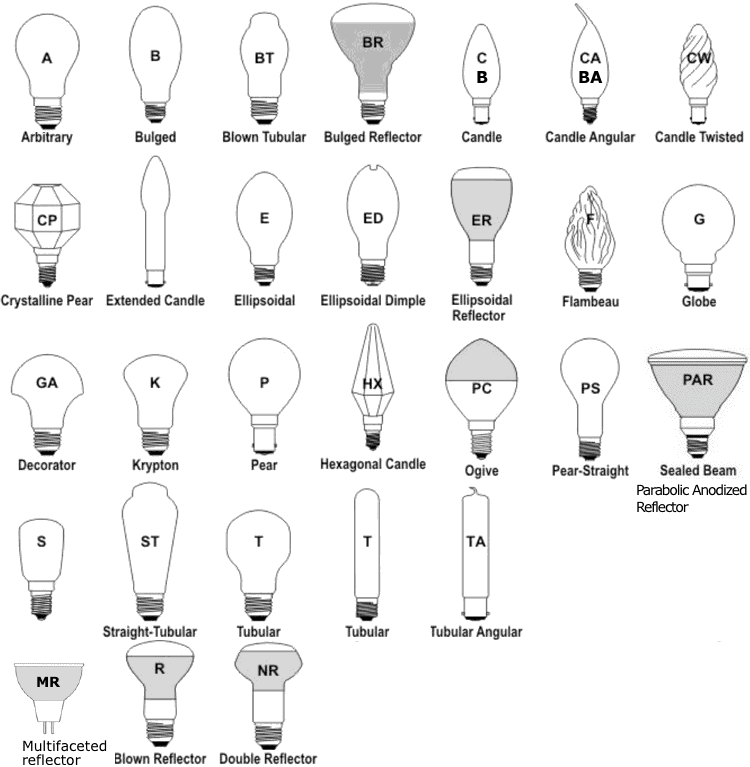
Next there are different types shapes of lights. For me, I don't care a lot about the shapes as long as they fit but here are a few:
Bases
Next are the bases. My house only has screw type bases with three main sizes. I have the E26 (standard), one fan has the E17 Intermediate and I have several fans that have the E12 (Candelabra) base.
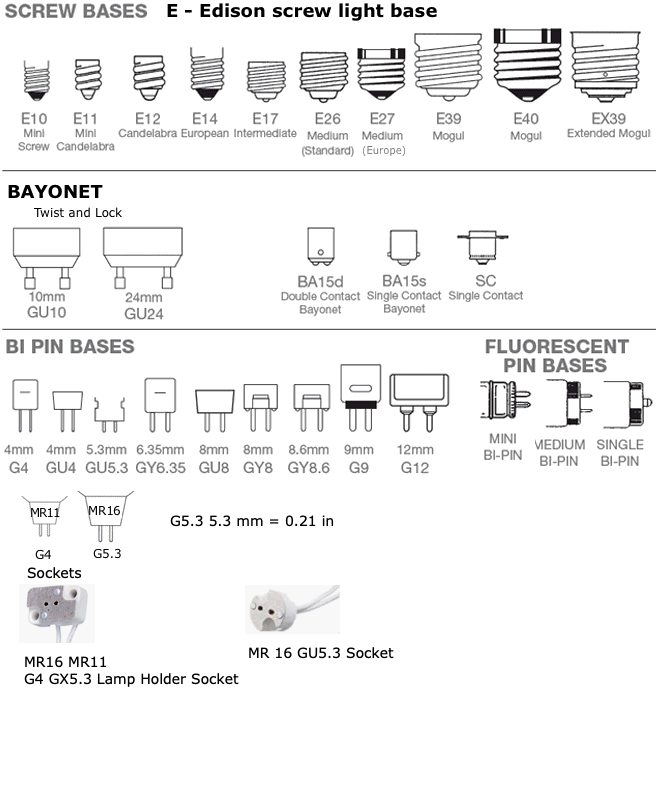
I know, there's so many combinations that it will make your head spin!!
But once you figure out the types of bulbs you need it's fairly simple to go and start buying replacements.
Example
One of my fans for instance has 4 (40w) incandescents at 450 lumens each. I just purchases 4 7.5W (they say 40 w equivalent) 500 lumen LED lights that are 3000k color on Amazon for $28.
Another bonus is that these lights are actually a little brighter than what I replaced since they are 500 lumens versus 450.
The LED's are rated for 25,000 hours of usage. At 3 hours a day they should last 22.8 years!
At 11 cents/Kwh, these bulbs will cost $.90 / year to operate x 4 bulbs = $3.60.
A regular 40 W incandescent at 3 hours/day would cost $4.80. It would cost $19.20/year to operate these bulbs.
Let's assume the incandescent bulbs were free. The LED bulbs cost me $7 each or $28 for the set. Since I'm saving $15.60/year then my break-even point would be 1.8 years. That's not bad!
Obviously the less you use the lights then the longer the break-even period would be. If you only used the lights 1 hour a day then the break-even would be 5.4 years.
I do have some outside lights that are 60W and I leave on about 8 hours a day so these were the first to get replaced.
I plan to replace the bulbs that I use the most first and work my way to the ones I use the least.
This will also help me meet one of my 2014 Goals of reducing my electricity usage.

LEDs are the future, definitely!
ReplyDeleteI have a lot of LEDs in my house.
The longer the light is on, the higher the money-return of the LEDs.
And some LEDs, you can dim!
Very cool in the sleeping room ;-)
Regards!
D-S
Hi D-S,
DeleteYou're right, I'd rather replace them now so I can start seeing some savings.
Take care
Just found the blog and am enjoying it so far. I think we have a similar investing strategies and goals. I agree with replacing your bulbs with LEDs. I think a lot of people overlook their power consumption and consider it something that's just part of life, not thinking about how they can lower it.
ReplyDeleteI know you have some solar panels so I'm sure you've already reviewed the insulation in your attic, but I got some spray foam insulation in my attic and it made a huge difference in my energy consumption. Might be something to look into if you haven't already.
Hi Chris,
DeleteI'm glad you enjoy the blog. I just took a look at your site and I hope you make all of your goals this year. That's great that you already have one rental paid for.
When I installed my solar system, it included a monitoring system so I can instantly see how much power I'm using. This really opened up my eyes and I'm trying to reduce my usage as much as possible.
Yeah, if you read through my solar posts I had mentioned having to do an energy audit. Part of that audit was to seal up all of the ducts in the attic and make sure there was sufficient insulation. My house already added that additional insulation that you're talking about.
Take care and I hope you keep stopping by!
Do LEDs work well on dimmers? I didn't even think about that when we purchased our house and pretty much all of the main areas have dimmers. I had no idea there were different base types other than the screw in and flourescent. That's just plain ridiculous!
ReplyDeleteYou can not dimm LEDs with a "normal" dimmer.
DeleteNormal lamps, you can give more or less power. And then they will be lighter or darker.
An LED is a diode, and no lamp.
Because of that, you need a spezial dimmer for the LED-Lamps!
If you have this spezial dimmer, it works well!
A german article: translate it please with google...: http://goo.gl/J9hpZ
regards
D-S
PIP,
DeleteSome do, you can look up online which work with dimmers. My house is also set up with dimmers all over so I've had good experience with some and some of the LED's will flicker on the dimmer.
Yeah, I didn't realize all the different types until I started to replace some of them. It's crazy they can't go with one easy standard. It reminds me of all the different types of charger ports on phones before they are mostly the micro USB and apple's newest one now.
We have Incandescent all over our house. Looks like we need to update ours to LED as well. Thanks for the article.
ReplyDeleteHI FFdividend,
DeleteI'd definitely update the ones you use the most. At least go CFL but I'd suggest LED. I had some CFL's that went out early and LED's will pay back the most money over time.
When I finished building my house I saw led bulbs for the cans in my kitchen. They were clearanced for $7 each (originally $24~ ouch). I bought 4 of them and installed them in March. Were well into Jan. and I haven't had to replace a single bulb yet! My old house always had issues with can-light bulbs going out on me. I am now a fan of LEDs and have been slowly replacing my bulbs with LEDs as they burn out, this way I don't break the bank all at once.
ReplyDeleteHi IE,
DeleteThat's one of my next areas to replace. My kitchen cans are using over 200W! I'm waiting to find a good deal on some.
I like the idea of slowly replacing them. It's not such a big hit all at once as you mention. I'm glad they are working out for. I'm exciting to see how much I can reduce my usage with new lighting.
Thanks for stopping by!
Great article, I've been buying the CFL bulbs for a few years now but I think I'll have to give the led bulbs a try.
ReplyDeleteHi Captain,
DeleteI also bought some CFL's and were using them in my lantern lights by my front door. However, they are terrible in cold weather! They have about half the brightness and take a while to warm up. I replaced them with LED's and they are instant on and do well in wet or cold weather.
Cheers
Fascinating AAI, I am going to have to look into some LEDs for my house. I have a light out front that is on throughout the "dark hours" and would greatly benefit from being more energy efficient. Probably averages 10 hours a day... yikes.
ReplyDelete*goes to Amazon...*
Hi writing2reality,
DeleteThat's the first lights I changed out, my outside lights I leave on all night. You'll break even before your first year most likely and then be saving for many year to come. People see that big upfront cost as a deterrent but the energy savings more than makes up for it.
Take care
As always I commend not only you, but our personal finance community, for urging others to think ahead about their (financial) actions.
ReplyDeleteIt's true. Everyone has the opportunity for early FI if they just work at it!
DeleteCheers!